How Long Do Roller Bearings Last?
There is no fixed answer to how long a roller bearing can last. It may range from a few thousand hours to tens of thousands or even over 100,000 hours, depending entirely on actual operating conditions. In engineering practice, however, bearing life is commonly evaluated using the rated life (L₁₀ life).
1. How Is “Bearing Life” Defined in Engineering?
The most widely used standard is the L₁₀ life (basic rating life), which refers to:
The total number of revolutions (or operating hours) that 90% of a group of identical bearings can achieve under the same operating conditions without showing fatigue spalling.
In other words, L₁₀ life represents a 90% reliability level, not an exact service life, but a statistically based design reference value.
2. L₁₀ Life Calculation Formula
For roller bearings (including cylindrical roller, tapered roller, and needle roller bearings), the basic rating life is calculated as:
L10=(PC)310×106(revolutions)
Where:
| Symbol | Meaning |
|---|
| C | Basic dynamic load rating (N), determined by bearing model (from catalog) |
| P | Equivalent dynamic load (N), the actual applied load |
| 10/3 | Life exponent for roller bearings (for ball bearings, it is 3) |
Converted into operating hours:
L10h=60×nL10
Where n is the rotational speed (r/min).
3. Difference Between Actual Life and L₁₀ Life
In real applications, bearing life may differ significantly from L₁₀ because L₁₀ only considers material fatigue. Actual failures are often caused by other factors:
| Factor | Impact on Bearing Life |
|---|
| Poor lubrication | Life reduced to 1/10 ~ 1/100 of L₁₀ |
| Contamination (dust/moisture) | Life reduced by 50% ~ 90% |
| Improper installation (misalignment/interference) | Life reduced by 50% ~ 80% |
| Overload beyond rated capacity | Life decreases sharply due to exponential effect |
| Excessive temperature | Lubricant failure and reduced material hardness |
| Maintenance condition | Regular relubrication can significantly extend service life |
4. Typical Service Life Ranges in Practical Applications
| Application | Typical Life Range (hours) |
|---|
| General industrial motors (light load, good lubrication) | 20,000 ~ 50,000+ |
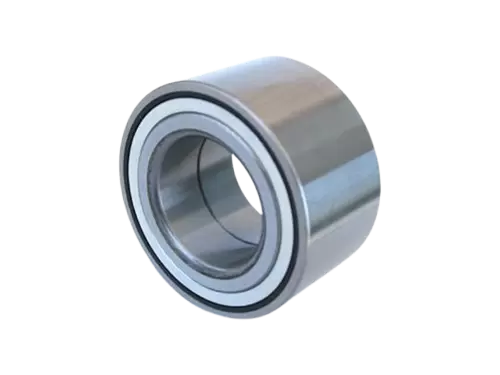
| Automotive wheel hub bearings (medium load, impact load) | 50,000 ~ 150,000 km (approx. 3,000 ~ 10,000 hours) |
| Machine tool spindles (precision, high speed, preload) | 10,000 ~ 30,000 |
| Heavy mining equipment (harsh environments) | 5,000 ~ 20,000 |
| Household appliances (low load, low speed) | 30,000 ~ 50,000+ |
5. Key Recommendations
1. Calculate L₁₀ during selection
Always base design on load and speed to ensure the required service life is met.
2. Actual life depends heavily on lubrication and maintenance
Around 80% of premature bearing failures are related to lubrication issues. Regular relubrication or oil change is the most effective way to extend life.
3. Ensure proper installation quality
Avoid hammering, misalignment, and improper interference fits.
4. Monitor operating conditions
Use vibration, temperature, and noise monitoring for early warning to prevent unexpected failures.